

A custom gate design comes together when style, scale, material, hardware, and automation all line up with the house and the driveway, and getting that combination right takes a clearer set of decisions than most owners expect.
Choosing a custom gate design for a Southern California home means making a series of decisions that look small in isolation and end up driving the entire feel of the property's curb appeal. The picket pattern, the spacing, the finial style, the gate hardware, whether the gate swings or slides, and how it integrates with the driveway columns and the house architecture all interact. Get the style right and the gate becomes the first thing visitors notice in a positive way. Get one of the inputs wrong and the gate reads as an afterthought, no matter how well-fabricated the metal is underneath. This guide walks through the actual decisions Southern California owners make when commissioning a custom iron or aluminum gate, in the order they tend to come up.
Start With the House: What Does the Architecture Ask For
The first conversation with any custom gate designer should focus on the house itself, not the gate. Mediterranean and Spanish Colonial homes call for one design vocabulary. Mid-century modern homes call for a completely different one. Ranch, Craftsman, and contemporary California-modern each have their own conventions. A gate that ignores the house's architecture lands as either generic or jarring.
For the four most common Southern California architectural styles, the gate-design starting points look like this:
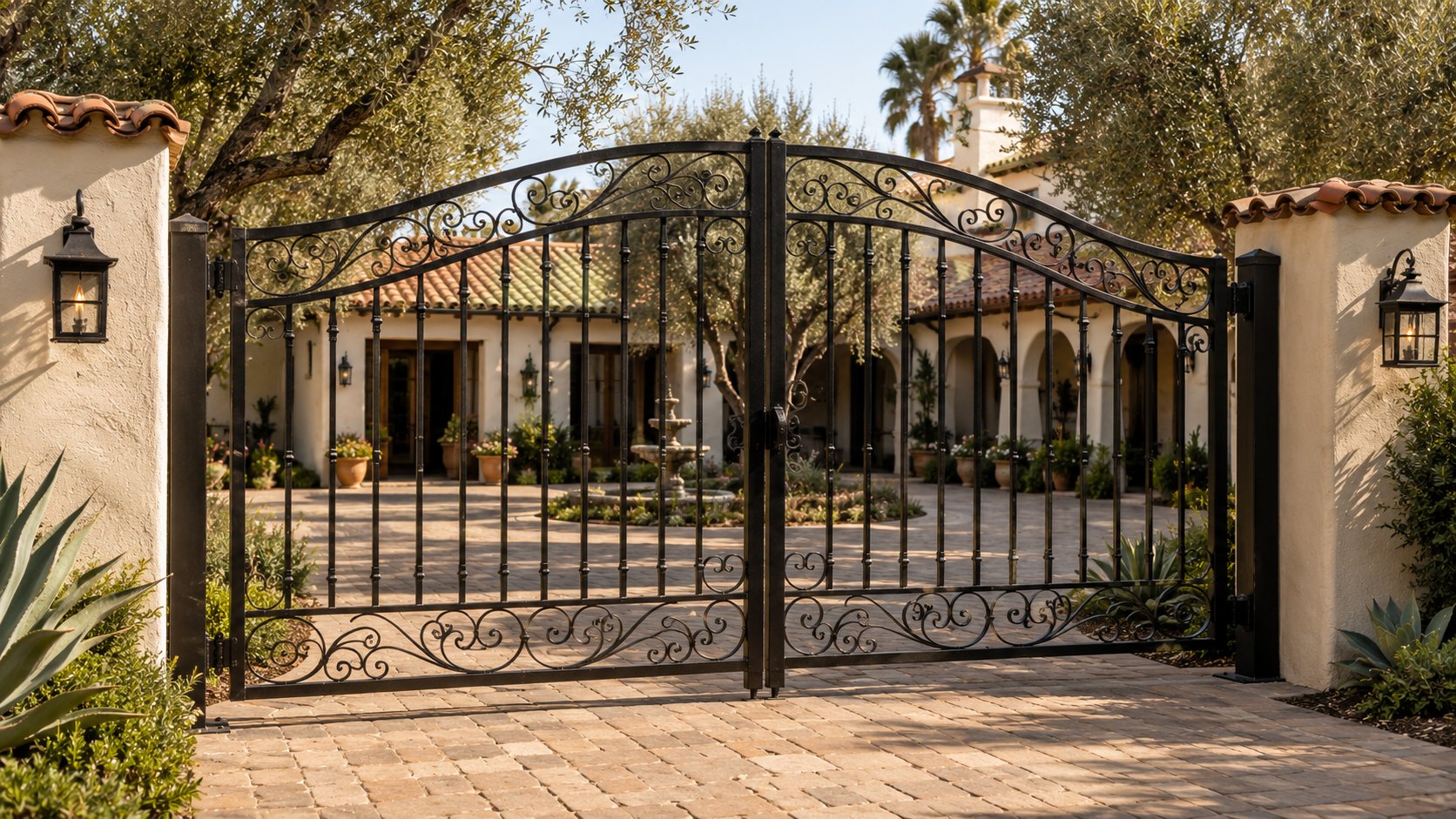
- Mediterranean and Spanish Colonial, scrollwork, twisted bars, finial accents, deeper picket spacing, warm bronze or oil-rubbed finishes
- Mid-century modern, horizontal slats, clean rectangles, minimal ornamentation, matte black or natural anodized finishes
- Ranch and farmhouse, simpler vertical pickets, X-bracing accents, hammered or distressed finishes, occasionally raw or weathered steel
- Contemporary California-modern, perforated panels, asymmetric layouts, integrated lighting, powder-coated matte finishes
This isn't a strict rulebook. Plenty of homes blend two styles deliberately, and a great custom designer can build a hybrid that honors both. But the architectural starting point is where most successful designs begin.
Scale and Proportion: Sizing the Gate to the Driveway and House
The second decision is scale. A gate has to read as proportional to both the driveway width and the visible mass of the house behind it. A 14-foot driveway with a single-swing gate on a small bungalow needs different proportions than the same 14-foot driveway on a 5,000-square-foot Mediterranean estate.
Two practical proportion checks help most owners avoid the most common scaling mistakes:
- Gate height should sit at roughly 50 to 65 percent of the perimeter fence height (or in the 4-to-7-foot range for a freestanding driveway gate without flanking fence)
- Column or post mass should be 1.5 to 2 times the picket diameter so the gate reads as anchored, not floating
Driveways narrower than 12 feet usually call for a single swing gate or a single sliding gate. Driveways between 12 and 20 feet open up the double-swing option, which looks more formal and shaves a few feet off the back-swing arc. Driveways wider than 20 feet sometimes need a sliding gate to avoid impractical swing arcs, especially on properties where the driveway runs close to the house.
Material Choice: Iron, Aluminum, or a Hybrid
Iron and aluminum dominate Southern California custom gate work for good reasons. Each has trade-offs that shape the design conversation.
Wrought iron carries the most visual weight. Forged scrollwork, period finials, hammered details, and welded picket assemblies all read as custom and substantial up close. Iron also takes ornamentation well, which is why traditional and Mediterranean homes almost always end up specifying iron. The trade-off is maintenance. Coastal salt air corrodes raw iron, so coastal owners need either galvanized substrate, powder-coated finishes, or both. The full range of wrought iron gate and fencing covers traditional through transitional designs, with finish options that hold up in Orange County and San Diego coastal climates.
Aluminum carries less visual weight but reads as cleaner and more modern. It powder-coats beautifully, doesn't rust in salt air, and stays light enough that automation hardware lasts longer. Modern and mid-century-modern homes default to aluminum more often than not.
Hybrid designs combine the two: an aluminum frame with iron scrollwork accents, or an iron frame with aluminum infill panels. Hybrids work well when the house architecture calls for both visual weight and modern restraint, which is increasingly common in Orange County's newer hillside builds.
Privacy Versus Visibility: The Picket Spacing Decision
One of the most consequential decisions in a custom gate design is how much of the driveway and front yard the gate hides. Tight picket spacing reads as private and substantial. Wide picket spacing reads as welcoming and open. Solid panels read as enclosed and secure.
Three common patterns work well in Southern California:
- Open picket (3.5 to 4 inches between pickets), works for properties where the front yard is the visual feature and the gate frames it without hiding it
- Tight picket (1 to 2 inches between pickets), works for privacy-focused properties on busy streets or in dense neighborhoods
- Solid panel, works for properties that prioritize total privacy and security, common on coastal walk streets and in some gated communities
The same gate frame can hold any of the three infill patterns, which means owners can change their mind during the design phase without restarting the whole conversation. The decision is usually less about security (any of the three patterns is hard to climb if designed right) and more about what the property says to the street.
Hardware: Hinges, Locks, and the Pieces That Make It All Work
Gate hardware is the part that owners think about least and that fails first when chosen badly. Heavy-duty stainless steel or brass hinges sized for the actual gate weight last decades. Undersized hinges sag within months, even on a gate that looks fine on day one. Self-closing or weighted hinges add convenience and help with pool code compliance if the gate is pool-rated.
Lock options shape the daily experience of using the gate more than almost any other decision. The four common patterns:
- Manual key lock, simplest and cheapest, fine for low-traffic gates that the owner mostly uses by hand
- Electric strike with intercom, works when the gate is the main entry and the owner wants remote release for visitors
- Magnetic lock with access control, works for properties that want keypad, fob, or smartphone-based entry without keys
- Integrated lock with motorized opener, the most common modern setup, where the same opener that swings the gate also handles the lock and release
Our gate motor and lock systems selection covers all four patterns with hardware sized for the specific gate weight and material, which is the detail that separates a custom install from an off-the-shelf one.
Automation: When and How to Motorize
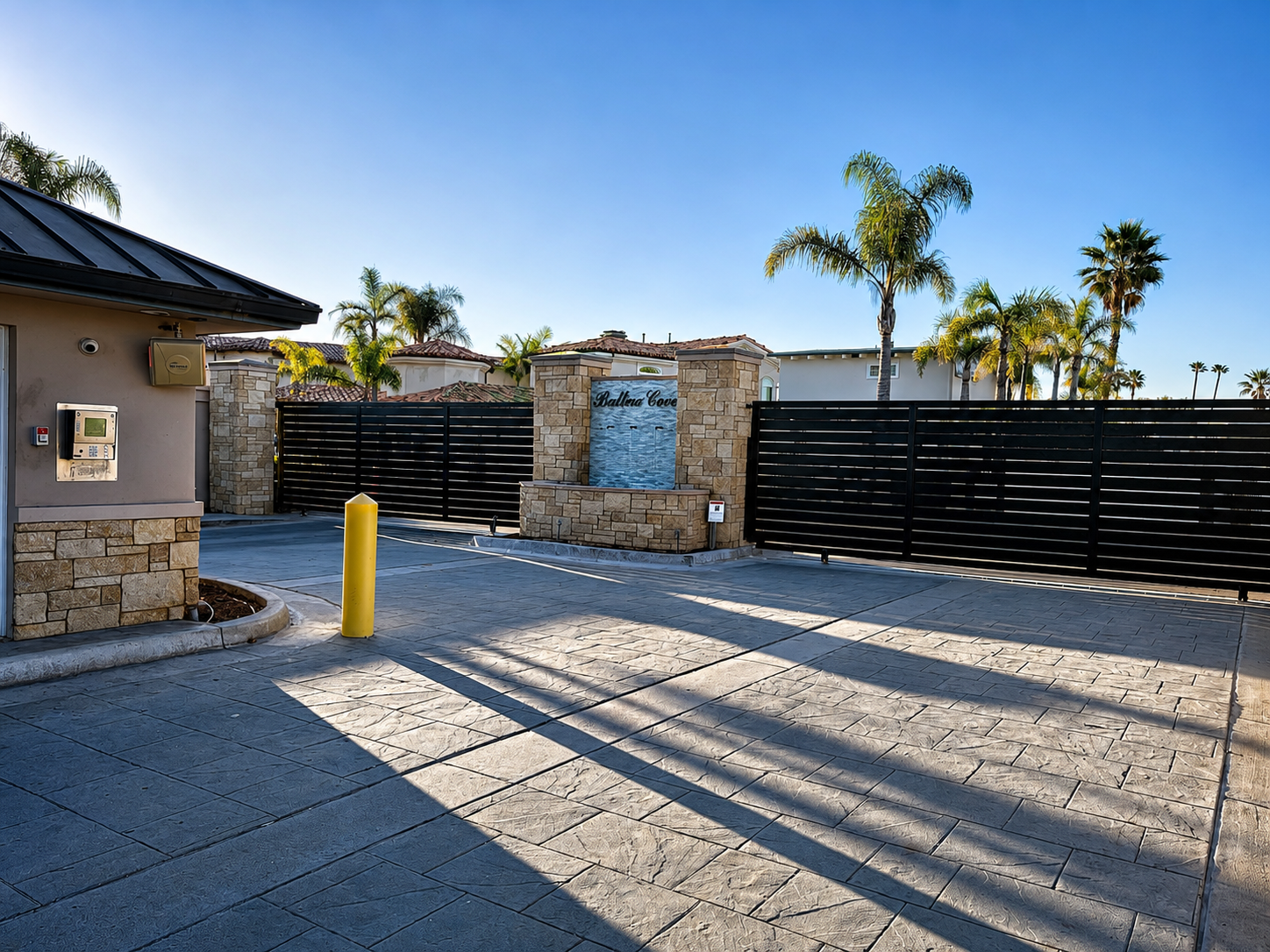
Most Southern California owners automate their custom gate at install rather than retrofitting later. The reason is simple: motorizing during fabrication lets the gate designer size the columns and the frame for the motor's torque and weight load, instead of working around what's already there. Gate weight matters more than owners realize. A heavy wrought iron gate needs a higher-torque opener with more demanding power requirements, while a lighter assembly from the aluminum driveway gate options reduces motor wear and extends the life of the automation hardware. Retrofits can still succeed, but they often expose undersized columns or hinges that have to be reinforced.
Three considerations drive the motor choice:
- Swing versus slide, swing gates need either underground or above-ground arm operators, slide gates need a track and a slide motor
- Battery backup, useful in neighborhoods with frequent power flickers or PSPS events, especially in hillside zones
- Access control integration, keypads, intercoms, smartphone apps, and HOA-required entry systems all need to be planned at install time
UL 325 safety standard governs gate automation in California. Any motor and gate combination installed today should meet UL 325 entrapment-protection requirements, which usually means photo-eye sensors on both sides of the gate path and edge sensors on the gate itself.
Permits, Setbacks, and the Local Conversation
Gate permits in Southern California vary by city and by gate type. A standard residential gate under 6 feet inside the property line usually doesn't require a building permit. A taller gate, a gate that involves significant column work, or any gate with an automated opener usually does. Pool fence gates have their own inspection through the pool permit process.
Setback rules can also affect the gate position. Many cities require the gate to sit a specific distance back from the property line so that vehicles waiting to enter have a place to pull off the public right-of-way. The setback can be 15 to 25 feet depending on the city and the street width. Owners in Newport Beach, Laguna Beach, Malibu, and other coastal jurisdictions sometimes face additional view-corridor or coastal commission rules.
The cleanest path is to design the gate with the local jurisdiction's known constraints in mind from the first sketch, rather than discovering them at permit submittal. A custom gate fabricator who works in your specific city should already know which way the local building department reads the rules.
From Design to Install: The Realistic Timeline
A typical custom gate project in Southern California runs eight to fourteen weeks from first design conversation to install, depending on the complexity of the fabrication and the permit picture. The breakdown:
- Two to four weeks for design refinement, drawings, and material selection
- Two to four weeks for permitting if required by the local jurisdiction
- Four to six weeks for fabrication, powder coating, and hardware procurement
- One to two weeks for installation, automation wiring, and final testing
Owners who want a gate in time for a specific date (a wedding, a holiday hosting season, a property sale) should start the conversation at least four months ahead. Rush fabrication adds cost and limits design options.
To talk through what a custom gate design would look like for your specific property, architecture, and driveway, talk to our team and we'll walk through the decisions in the order they come up.
FAQ
How much does a custom driveway gate cost in Southern California?
Custom driveway gates in Orange, LA, and San Diego counties typically run $4,500 to $18,000 installed, depending on size, material, hardware, and automation. Iron gates with elaborate scrollwork and full automation sit at the higher end. Simpler aluminum picket gates with basic openers sit at the lower end.
Should I choose iron or aluminum?
Choose iron when the home's architecture calls for traditional weight and ornamentation. Choose aluminum for modern and mid-century-modern homes, coastal properties where rust is a real issue, and projects where lower maintenance over time matters more than maximum visual weight.
Do I need a permit for a driveway gate?
It depends on the city and the gate. Standard residential gates under 6 feet inside the property line usually don't require a permit. Taller gates, gates with significant column work, and any automated gate usually do.
Swing or slide?
Swing gates work for most residential driveways. Slide gates work for narrow driveways where back-swing arcs are impractical, for very wide driveways, and for properties on steep slopes.
How long does the whole process take?
Eight to fourteen weeks from first design conversation to install for a typical custom gate.
