

TL;DR: Aluminum fencing is non-combustible per ASTM E136 and meets the spirit of California's new Zone 0 ember-resistant rules, making it the practical choice for perimeter and pool fences in WUI neighborhoods across Southern California.
Fire-safe fencing has moved from a nice-to-have to a building-code conversation in Southern California, particularly in Orange County's foothill neighborhoods, the Santa Monica Mountains, and the inland valleys of San Diego County. AB 3074 established a new defensible space rule called Zone 0, a five-foot ember-resistant area around any structure in a Fire Hazard Severity Zone. New construction in Very High FHSZ areas falls under the rule starting February 28, 2026, with existing properties expected to come into compliance by February 2027. The headline for property owners with iron, wood, or vinyl fences along the structure-side perimeter is that combustible material within those first five feet has to go. Aluminum, which is non-combustible by the ASTM E136 test that the building code uses for material classification, sidesteps the problem cleanly and works as both the property perimeter and the pool barrier without code conflict.
What Counts as Fire-Safe Fencing in the New Code Environment
California's wildfire codes look at fence materials through two lenses: combustibility and ignition pathway. Combustibility is a binary classification. A material either passes ASTM E136 (the standard test for combustibility) or it doesn't. Aluminum passes. So do steel and wrought iron. Wood and most composites do not. Vinyl is a separate conversation; the polymer doesn't ignite easily but it does melt and deform under sustained radiant heat, which can compromise the barrier function during a wildfire.
Ignition pathway is the more nuanced concern. Wildfires in Southern California spread primarily through ember showers, not direct flame contact. Embers travel half a mile or more ahead of an active front and ignite whatever combustible material they land on. A wood fence attached to a stucco wall becomes a wick: the fence ignites from an ember, the flame climbs the fence, and the wall starts to char from the bottom up. Removing the combustible fence (or replacing the first five feet with a non-combustible material) breaks the wick.
This is the logic behind Zone 0. The Cal Fire defensible space zones reference defines Zone 0 as 0 to 5 feet from the structure, Zone 1 as 5 to 30 feet, and Zone 2 as 30 to 100 feet. The Zone 0 rule (when fully enforced) prohibits combustible materials, including wood and vinyl fences attached to the structure, within that first five-foot perimeter.
Why Aluminum Wins on Fire-Safe Performance
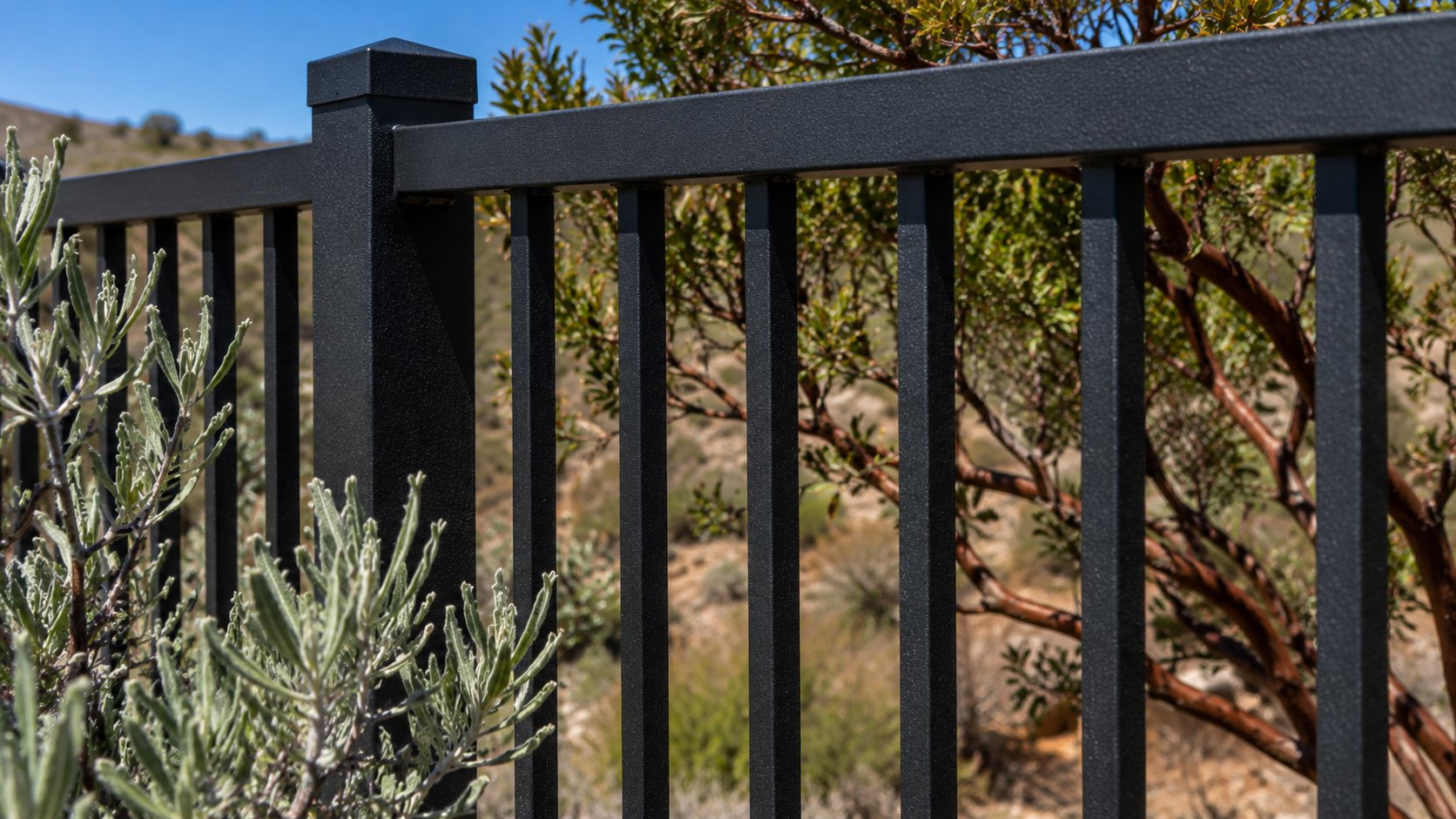
Aluminum has a melting point around 1,220 degrees Fahrenheit. Wildfire flame temperatures can briefly exceed that during peak intensity, which leads some owners to ask whether aluminum is really fire-safe in a true wildfire. The honest answer is that no fence material survives direct sustained flame contact in a major wildfire, but aluminum performs in the way the code asks for: it does not ignite, it does not propagate flame along its length, and it does not act as a wick that feeds fire toward the structure.
Three practical advantages make aluminum the default choice for fire-safe perimeter fencing in Southern California:
- Non-combustible classification under ASTM E136 means no ignition from ember showers and no flame spread along the fence material itself
- Powder-coated finishes hold up against UV and salt air better than painted steel, which matters for fences that face years of coastal Santa Ana winds
- Code-friendly geometry through prefabricated panels and pickets that meet the pool fence spacing rules without custom fabrication
Cost is the practical trade-off. Aluminum sits between vinyl and wrought iron on installed price per linear foot. The premium over wood or vinyl shows up at the time of install, then disappears over the life of the fence because aluminum requires almost no maintenance.
Zone 0, Zone 1, and Zone 2: What Each Zone Requires of the Fence
The three defensible space zones have different rules, and the fence design needs to respect the right one for each location on the property.
Zone 0 (0 to 5 feet from the structure) is the strictest. Once the new rules are in full effect, combustible materials are prohibited entirely. A fence in this zone has to be aluminum, steel, wrought iron, masonry, or similar non-combustible material. Vinyl is excluded. Wood is excluded. The Zone 0 rule also covers gates, attached arbors, attached planters, and any other built feature in the first five feet.
Zone 1 (5 to 30 feet from the structure) allows combustible materials but applies vegetation and ignition-source restrictions. A wood or vinyl fence is permitted in Zone 1 provided it doesn't connect a fuel source (like landscape mulch) to the Zone 0 perimeter. A common pattern in Orange County hillside neighborhoods is aluminum fencing in Zone 0 around the structure, then wood or composite fencing along the property line out in Zone 1 or beyond.
Zone 2 (30 to 100 feet) focuses on vegetation management and fuel break maintenance. Fence material restrictions ease significantly in this zone, and the conversation shifts to keeping vegetation cleared and creating a defensible buffer.
Lots in the Santa Monica Mountains, the Santa Ana Mountains, and the San Diego County backcountry that fall in Very High FHSZ designation get the strictest enforcement of all three zones. Lots in Moderate or High FHSZ get a lighter version of the same rules. The specific Fire Hazard Severity Zone map for any given address is on the Cal Fire FRAP viewer.
Designing an Aluminum Fence That Meets Both Fire and Pool Code
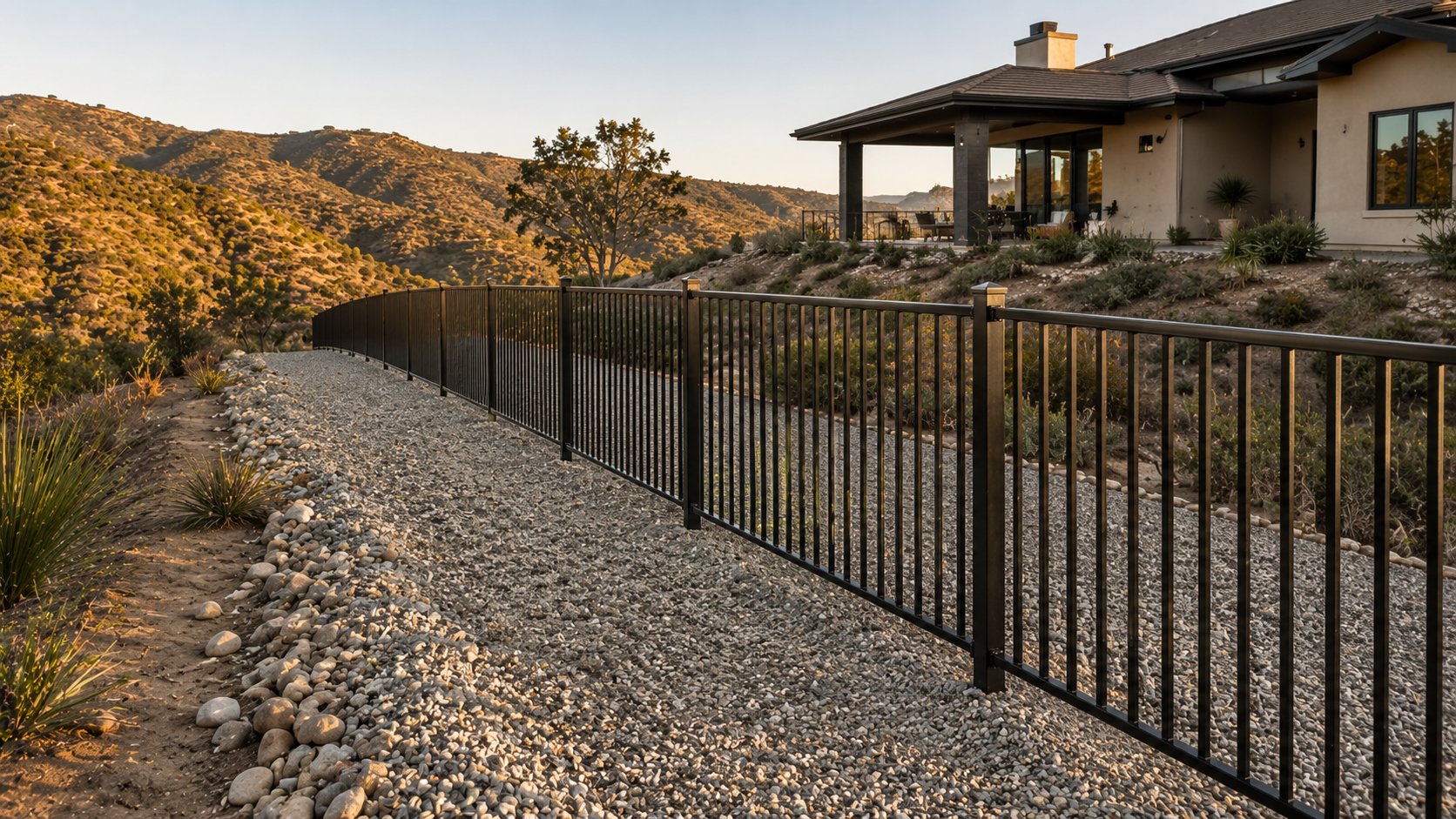
Many Southern California properties end up needing a single fence design that handles both jobs: the pool barrier inside the property and the structure-side perimeter that has to meet Zone 0. Aluminum handles both cleanly because the same prefabricated picket assemblies that pass pool code (4-inch sphere rule, 60-inch height, self-closing self-latching gate) also satisfy the non-combustible material requirement for Zone 0.
A few design notes that tend to come up:
- Vertical picket designs are the most common pool-and-perimeter solution. The same panel that satisfies the sphere rule satisfies Zone 0.
- Horizontal slat designs (popular in modern California-modern architecture) need careful spacing to pass pool code. The horizontals can read as climbable if the rails are too far apart.
- Powder-coat color choice matters for long-term appearance. Darker colors absorb more heat and can fade slightly faster in coastal sun, though premium powder coats hold up well in either palette.
- Gate hardware needs to be non-combustible too. Aluminum or stainless steel hinges and latches are standard. Plastic-bodied magnetic latches and self-closing hinges with plastic components are not ideal in true WUI zones.
Our powder-coated aluminum fencing line includes pool-code spacing and Zone-0-compatible designs as standard configurations, which removes most of the custom-fabrication work for owners in fire-prone neighborhoods.
Insurance, Resale, and the Long View
Insurance carriers in California have spent the last several wildfire seasons tightening underwriting in high-risk zip codes. Several carriers now ask explicitly about Zone 0 compliance during renewal. Whether a property qualifies for coverage at all, and at what premium, increasingly depends on the defensible space picture, including the fence materials within the first five feet of the structure.
Resale value tracks the same way. Buyers in WUI neighborhoods are starting to ask about Zone 0 compliance the same way they ask about roof material, attic vents, and ember-resistant siding. A code-compliant aluminum fence is now a checklist item on many escrow disclosure forms in Orange County's foothill ZIPs and in the canyon neighborhoods of LA County.
Our residential fence options cover both the structure-perimeter aluminum and the property-line fencing in one design conversation, which keeps the install clean and the inspector happy.
Common Mistakes Owners Make on the First Pass
The most common mistake is replacing only the obvious part of the fence and leaving combustible attached features in Zone 0. A wood arbor over a side gate, a wood trellis attached to the structure, or a wood planter box anchored to the wall all count as combustible material in Zone 0 even after the fence itself is replaced.
The second common mistake is choosing a powder-coat color that fades quickly under sustained UV. Premium powder coats from major manufacturers (TGIC polyester, fluoropolymer top coats) hold up well in coastal sun. Lower-grade powder coats can fade noticeably in three to five years, which adds an unnecessary refinishing cost down the line.
The third is skipping the local jurisdiction check. Defensible space rules are state-level, but enforcement and inspection happen at the city or county level. Pasadena, Malibu, Calabasas, Laguna Beach, and many other Southern California cities have their own additional WUI ordinances on top of the state rule. The right installer knows the local interpretation and designs the fence to clear the strictest reading.
Working Through Your Property's Fire-Safety Picture
Every property is different. The right fire-safe fencing strategy depends on the FHSZ designation, the existing fence materials, the proximity to the structure, and the insurance and resale picture for the specific neighborhood. The cleanest path is a walk-through that maps the Zone 0, Zone 1, and Zone 2 perimeters against the current fence and the future build, then picks the right aluminum profiles and finishes for the structure-side runs.
To talk through your property's defensible space picture and what an aluminum fence install would look like, request a custom quote and we'll walk through the design, the code interpretation, and the installation timeline.
FAQ
Is aluminum fencing really fire-safe?
Aluminum is classified as non-combustible under ASTM E136, the standard test that California building code uses for material classification. It does not ignite from embers and does not propagate flame along its length, which is what the Zone 0 rule asks for. In a major wildfire, no fence material survives direct sustained flame contact, but aluminum performs the way the code expects.
Does my property need a Zone 0 fence?
Zone 0 applies to properties inside California's Fire Hazard Severity Zones, with the strictest enforcement in Very High FHSZ. New construction in Very High FHSZ falls under the rule starting February 28, 2026. Existing properties are expected to come into compliance by February 2027. Check the Cal Fire FRAP viewer for the FHSZ designation on your specific address.
Can I keep my wood fence outside of Zone 0?
Yes. Zone 0 covers the first 5 feet from the structure. Wood fencing is allowed in Zone 1 (5 to 30 feet) and beyond, subject to local jurisdiction rules and vegetation-management requirements. Many Southern California properties end up with aluminum in Zone 0 and wood or composite along the property line.
How does aluminum compare to wrought iron on fire safety?
Both materials are non-combustible and meet Zone 0 requirements. The choice usually comes down to maintenance and aesthetic. Aluminum requires almost no maintenance and stays affordable over the life of the fence. Wrought iron reads as more substantial up close and works better for traditional or Mediterranean architecture, with a higher maintenance cost in coastal salt air.
Will an aluminum fence affect my insurance premium?
Insurance carriers are tightening underwriting in high-risk Southern California zip codes, and several now ask about Zone 0 compliance and ember-resistant materials during renewal. A code-compliant aluminum fence in Zone 0 generally helps the underwriting conversation, though specific premium effects depend on the carrier and the property's overall risk profile. Confirm with your insurance agent before making material decisions purely for premium reasons.
