

TL;DR: Custom iron railings do a lot for curb appeal because they sit where people look first. Match the style to the house and have them powder coated for the coast.
Custom iron railings are guardrails and handrails made to fit one specific house. A fabricator measures the stairs, porch, or balcony, draws something that suits the architecture, and builds it in the shop. The difference from a railing kit is partly fit, since the proportions are right for your steps instead of a catalog's, and partly what goes between the top rail and the ground. With custom work that can be scrollwork, plain bars, or thin stainless cable, and with a kit it is whatever the box comes with.
Below is what we tell homeowners who ask about railings: where they go, which styles work on which houses, what finish holds up near the ocean, and the code rules that decide a surprising amount of the design.
Why a Small Piece of Iron Matters So Much
Compared with a driveway gate or a full fence, a railing is not much metal. It just happens to be in the spot everyone looks at. The front steps, the landing by the door, and any balcony facing the street are usually the first things a visitor notices about a house, and all three tend to have a railing on them.
A railing that does not match the house stands out more than you would expect. We see this a lot on Spanish-style homes in San Clemente and San Juan Capistrano that have a plain aluminum kit railing bolted to the front steps. It is not ugly, exactly, but it looks like it came from a different building. Put a hand-forged railing with a little scrollwork on the same steps and it looks like it was always there.
There is also how it feels. Iron is heavy and gets anchored into the concrete or the framing, so it does not wobble when you grab it. People notice that without really thinking about it, and it is a big part of why iron is still the default on nicer homes in Orange County and the South Bay.
Where Railings Go on a House
Most of the railing work we do falls into four spots, and each one has its own considerations.
Front Steps and Porches
Entry railings need a handrail you can actually hold, plus a guard if the porch is more than 30 inches off the ground. Since this is the railing people see from the sidewalk, it is the one worth spending a little more on. A forged scroll, a nice newel post, or a cap rail that picks up the finish on the front door hardware all go a long way here. It is also where custom metal railing systems look most obviously different from kit railings, because you are standing right next to them.
Balconies
Balcony railings get seen from below and from across the street, so the overall pattern matters more than fine detail. Plain vertical pickets with a top and bottom rail look right on most stucco houses. Horizontal bars suit the newer, boxier homes going up in Costa Mesa and Irvine.
Juliet Balconies
A Juliet balcony is just a railing across a full-height window or door opening, with no platform to step out onto. It is an inexpensive way to dress up a second story, and because the railing is the whole feature, it is one of the few places where more decorative scrollwork makes sense. You see them on a lot of Mediterranean and Tuscan-style houses in Newport Coast and Rancho Santa Fe.
Exterior Stairs and Decks
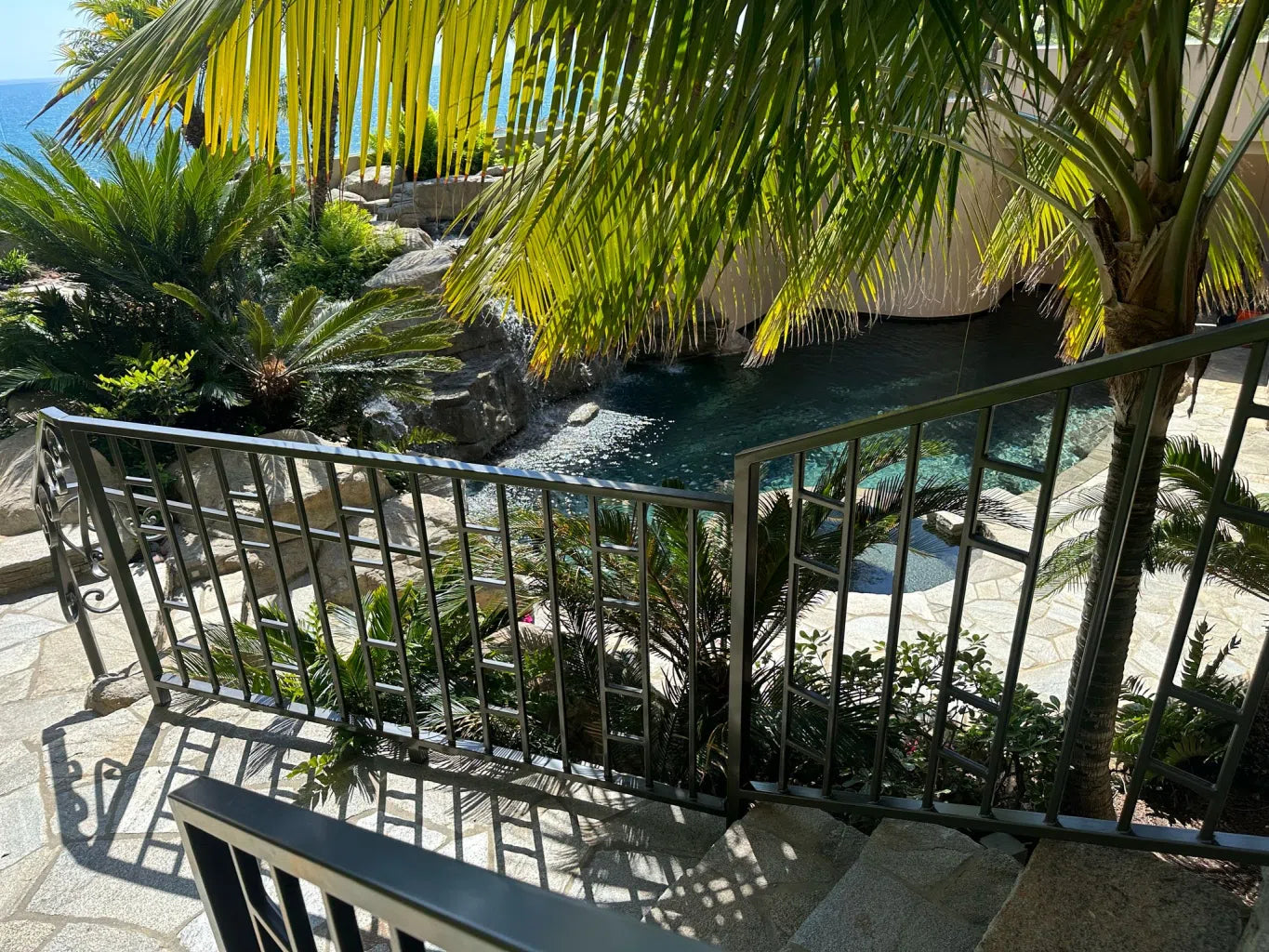
Hillside lots in Laguna Beach, Palos Verdes, and parts of San Diego County often have outdoor stairs and raised decks, and the whole point of those is the view. The railing has to keep people safe without blocking it. Cable or thin horizontal bars are the usual answer, and this is where you want a frame that was engineered for the span rather than something off a shelf, because cable railings depend on the frame staying rigid.
Scrollwork, Bars, or Cable
The infill is where the style comes from, and the honest advice is to match the house rather than whatever is popular this year.
Scrollwork belongs on Spanish, Mediterranean, Tuscan, and older traditional homes. The key is not to overdo it. A C-scroll or S-scroll repeated every few pickets looks good, while a railing packed with curls looks like a hotel in a theme park.
Forged scrolls, the ones with tapered ends that were actually bent by hand, look noticeably better up close than cast decorative pieces that get welded on.
Straight bars and simple grids work for ranch houses, mid-century homes, modern farmhouses, and almost anything built in the last ten years. Here the decisions are about proportion: how thick the pickets are, how far apart they sit, and whether the top rail is a flat bar, a round cap, or a wood handrail mounted over the iron.
Cable infill means stainless steel cables run horizontally through an iron or steel frame and pulled tight. From a few feet away it almost disappears, which is why it is so common on view lots. The frame has to be stiff enough to hold the tension, so the posts are usually closer together than they would be with pickets. Plan on having the cables re-tensioned every few years, sooner if you are near the water.
Finishes That Hold Up Here
A railing is only as good as its coating, and this part of the coast is hard on metal. Within a few miles of the beach in Huntington Beach, Long Beach, or La Jolla, salt air will find any spot where the coating is thin. Inland, in Riverside County, the problem is sun, which fades and chalks a cheap paint job in a couple of summers.
Powder coating handles both. The railing gets sandblasted, primed with a zinc-rich primer if it is going near the ocean, and then coated with a dry powder that is baked on. It comes out as a hard, even shell with no drips or thin spots, which is something hand-painted scrollwork never quite manages. It lasts many times longer than brushed paint.
For color, most people go with matte or satin black. It works against nearly any facade and does not show dust. Bronze and dark brown suit Tuscan and Spanish color schemes. On newer homes with white stucco, we have been doing more warm charcoal lately, since pure black can look a little severe against all that white.
The Code Rules You Have to Design Around
Railings have more rules than people expect, and it helps to know them before you fall in love with a design. The 2022 California Residential Code requires a guard anywhere a walking surface is more than 30 inches above the ground below it. At porches, balconies, and landings that guard has to be at least 42 inches tall, and on the open side of a stair it can be 34 inches, measured from the stair nosings.
Guards also cannot have any opening big enough for a 4-inch ball to pass through, which is what sets the spacing between pickets or cables. Section R312 of the California Residential Code has the full text, including the handrail rules for stairs.
Those numbers knock out a few looks that photograph well. Widely spaced horizontal bars, the kind you see in design magazines, usually fail the 4-inch rule. A cable railing with slack cables can fail it too. A fabricator who deals with this every day will design around the limits from the start, which is a lot better than finding out at inspection.

Matching Railings to the Gate and Fence
The houses that look best from the street are the ones where the railing, the driveway gate, and the front fence all share the same picket profile, the same top rail, and the same finish color. It reads as one design rather than three separate purchases.
The simplest way to get that is to have one shop build all of it, so the scroll on the porch railing shows up again on the pedestrian gate, and the same satin black runs across the wrought iron gate and fencing out front. Even if the pieces get built years apart, a shop that keeps the drawings and finish codes on file can match the earlier work.
If you already have a gate, a railing project is a good time to look at the front of the house as a whole and decide whether everything is working together.
What a Railing Project Looks Like
It starts with a site visit. Someone comes out and measures the stairs, landings, and whatever the railing will mount to, because railings built from a drawing instead of the actual steps never fit quite right. Then the design gets sketched against photos of the house, you pick the infill and the finish, and the piece gets built in the shop. Installing a typical porch or balcony railing usually takes a day or less, with the posts core-drilled into concrete or bolted through the framing.
If you are thinking about new railings anywhere in Orange County, Los Angeles County, or San Diego County, the quickest way to get a realistic design and price is to talk to our team and send a few photos of the stairs or balcony. A look at the house usually settles the style question pretty fast.
Frequently Asked Questions
Do custom iron railings really improve curb appeal?
Yes. Railings sit on the front steps, the landing, and the balcony, which are the first things people see. A railing that matches the house makes it look finished, and a generic kit railing tends to look like a shortcut. For the amount of metal involved, the effect is bigger than you would guess.
Which railing style suits a Spanish or Mediterranean home?
Simple scrollwork. A forged C-scroll or S-scroll repeated between plain pickets, finished in matte black or dark bronze, matches the ironwork these houses were originally built with. Keep the pattern simple, and if you can, repeat it on the gate and fence so everything ties together.
How tall does an exterior railing need to be in California?
Under the California Residential Code, any porch, balcony, or landing more than 30 inches above the ground needs a 42-inch guard. On the open side of a stair the guard can be 34 inches, measured from the stair nosings. No opening in the guard can let a 4-inch ball through.
Will iron railings rust near the beach?
Bare or brush-painted iron will. Railings going in near the coast should be sandblasted, primed, and powder coated, which holds up for many years within a few miles of the ocean. Rinsing off salt film now and then and touching up chips when you see them stretches the finish even further.
Is cable railing a good choice for a view lot?
It is the least visible option, which makes it the usual pick for hillside decks and ocean-view balconies. It needs a stiff iron or steel frame with posts set closer together to keep the cables tight and within the 4-inch opening rule. Expect to re-tension the cables every few years, especially in salt air.
